.svg)
.svg)
ENTERPRISE AI
Change Is Moving at Machine Speed. Validation Should Too
Why Autonomous Validation Requires a New Enterprise Stack
The physics of enterprise IT are changing.
For decades, organizations managed change at a human pace. A software update required planning meetings, testing cycles, approvals, pilot groups, and deployment windows. The process was slow, but the volume of change was manageable.
That world no longer exists.
Enterprises now face a continuous stream of operating system updates, application releases, security patches, policy changes, cloud transformations, AI copilots, AI agents, and automated business workflows. The pace of innovation has accelerated dramatically. The way organizations validate change has not.
The result is a widening gap between how quickly enterprises can deploy change and how quickly they can determine whether that change is safe.
That gap is becoming one of the defining operational challenges of the AI era.
|
Validation needs a new enterprise stack. |
The Validation Problem Nobody Talks About
Most enterprise technology initiatives do not struggle because systems cannot be deployed. They struggle because organizations cannot confidently predict what will happen during or after deployment.
A patch touches an application. The application supports a workflow. The workflow affects a department. The department affects the business.
The challenge is rarely the change in isolation. It is understanding the ripple effect before users experience it.
Every enterprise environment has a unique digital DNA: applications, endpoints, dependencies, policies, configurations, and workflows that interact in ways few organizations fully understand. Traditional testing approaches capture
only a fraction of that complexity, often at a single moment in time.
AI raises the stakes. As the volume and velocity of change increase, validation cannot remain a periodic activity performed after decisions are already in motion.
Organizations need a connected system for understanding, evaluating, and governing change before it reaches production.
A Framework for the Autonomous Validation Stack
At WorkspaceDNA, we believe the next generation of enterprise operations will depend on five connected capabilities.
See how WorkspaceDNA validates change before deployment →
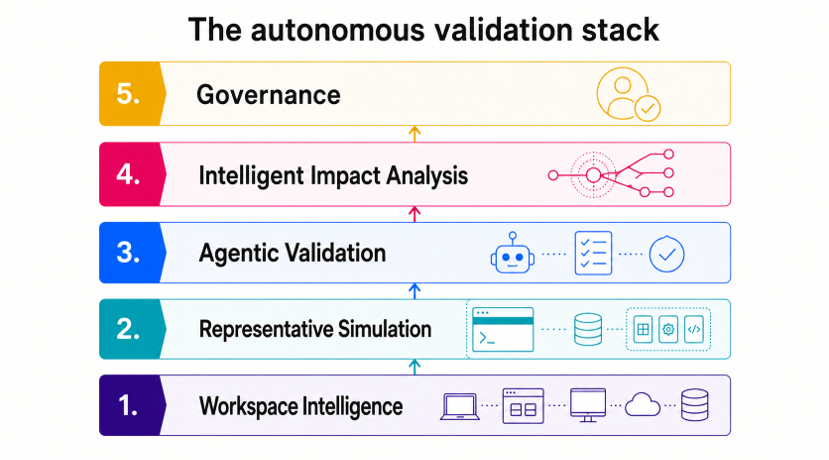
1. Workspace Intelligence
Everything begins with understanding the environment.
Before organizations can validate change, they need visibility into the applications, endpoints, configurations, dependencies, and workflows that make their business function.
WorkspaceDNA builds an evolving model of the enterprise workspace, helping IT teams understand how systems connect and where change may create downstream impact. This contextual intelligence is the foundation for every capability that follows.
You cannot validate what you cannot see.
2. Representative Simulation
Visibility alone is not enough. Organizations must be able to evaluate proposed changes under conditions that reflect their real-world environment. Representative workspace environments make it possible to examine how applications, configurations, and workflows behave before broader deployment.
Instead of relying only on generic test labs or assumptions, teams can validate change against the context of their own workspace.
The goal is straightforward: learn what a change will affect before users are asked to find out for you.
3. Agentic Validation
The defining characteristic of the AI era will not be how many agents an organization deploys. It will be whether the organization can verify what those agents do.
ATP360, WorkspaceDNA's autonomous validation engine, is designed to execute and evaluate tests across applications, operating system changes, endpoint configurations, and business workflows without depending on traditional test scripts for every scenario.
Instead of producing another layer of activity, ATP360 produces reviewable evidence. Instead of asking teams to manually repeat every test, it helps expand validation coverage. Instead of forcing validation to become the brake on change, it helps make confidence part of the process.
4. Intelligent Impact Analysis
Modern enterprises need more than a pass-or-fail result. They need to understand consequences.
WorkspaceDNA evaluates the potential ripple effect of change across applications, workflows, user groups, and business functions. By mapping relationships within the workspace, organizations can identify where disruption is most likely to appear and focus attention where it matters most.
Validation should not begin after something breaks. It should help teams anticipate where a change could create risk.
5. Governance
AI changes how work gets done. It should not remove human authority over the outcome.
WorkspaceDNA is built around a human-in-the-loop operating model. Autonomous validation can execute work, surface issues, and provide recommendations, while production deployment decisions remain with authorized IT and business stakeholders.
|
AI performs the work. Humans make the decisions. |
Autonomous does not mean unsupervised. It means reducing the manual effort required to produce the evidence people need to make informed decisions.
The objective is not less governance. It is faster, more intelligent, evidence-driven governance.
Why Windows 365 for Agents Matters
A significant portion of enterprise work still happens in Windows applications, browsers, virtual desktops, legacy systems, and complex user workflows. Many of these experiences cannot be fully tested through APIs alone.
Windows 365 for Agents represents an important advancement in making agentic work practical for the enterprise.
By providing purpose-built, enterprise-managed Cloud PCs for AI agents, Windows 365 for Agents gives agentic systems a secure and scalable place to operate. Microsoft Entra identity, Microsoft Intune management, Cloud PC isolation, and governed session controls help organizations extend familiar enterprise protections to agent-driven work.
This foundation allows agents to interact with applications and workflows in controlled environments while operating within the security, compliance, and management boundaries enterprises expect.
WorkspaceDNA is building autonomous validation capabilities for this environment: agents that can execute tests, validate workflows, surface issues, and generate audit-ready evidence before changes reach production.
Microsoft provides the secure, enterprise-managed execution foundation. WorkspaceDNA brings the contextual intelligence and autonomous validation capabilities that help organizations determine whether change is ready to move forward.
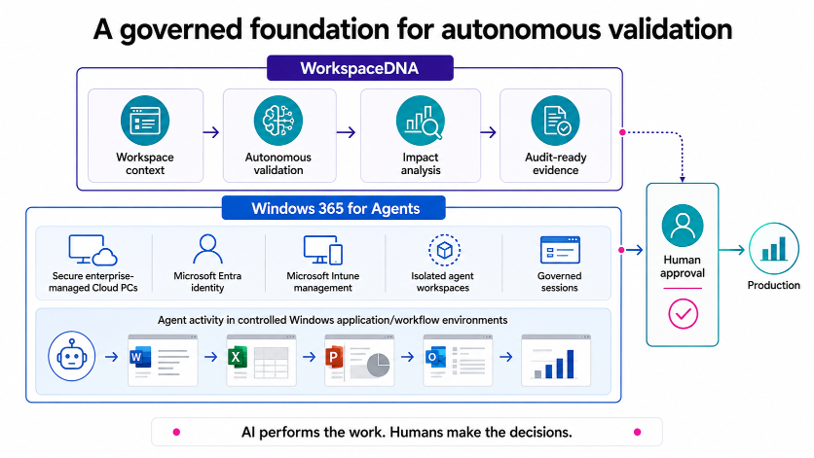
Together, these technologies open new possibilities for enterprise operations—not by removing control, but by making validation scalable enough to keep pace with change.
The Future of Enterprise IT
For years, organizations have been forced to choose between speed and safety.
Move quickly and accept more risk. Or reduce risk and accept more delay.
The age of AI demands a different answer.
Enterprises need systems that continuously understand context, evaluate change, validate outcomes, identify potential impact, and support governance at machine speed.
That does not mean autonomous decision-making.
|
It means autonomous validation. |
It does not replace IT teams. It expands their reach.
It does not remove governance. It makes governance more informed.
The enterprise environments of tomorrow will be managed by people working alongside AI systems that continuously validate the impact of change before users feel it.
That is the future WorkspaceDNA is building—and we believe it will define the next generation of enterprise operations.
.webp?width=290&name=Samit%20Headshot%20(1).webp)